SBT Partners
  • Total IT Management
        • AI Solutions
        • Helpdesk
        • Cybersecurity
        • Microsoft 365
        • Modern Cloud Services
        • Data Backup
        • Business Continuity
        • Infrastructure & Endpoint Management
        • Virtual CIO
        • Collaboration
  • Industries
    • Construction
    • Manufacturing
    • Nonprofits
    • Professional Services
    • Property Management
  • The SBT Partnership
    • SBT Solution Stack
    • The Modern Workplace
    • Technology as a Service
    • Procurement as a Service
    • IT Strategy Committee
    • SBT Partnership Rewards
    • About Us
  • Resources
    • Upgrade Your MSP
    • Blog
    • Videos
    • Careers
    • Locations
      • Charlotte
      • Detroit
  • Contact Us
  • Menu Menu
Managed Services Detroit Button CYBERSECURITY

The Real Cost of a Data Breach for a Small Business

Attackers frequently target small and midsized businesses because they tend to have fewer security controls and less visibility in place. This guide breaks down what a data breach actually costs, what causes them, and how a proactive IT strategy helps prevent a minor incident from becoming a major disruption.

When most people hear the term data breach, they tend to think of large enterprises making national headlines. In reality, small and midsized businesses are targeted just as often, and in many cases, for the opposite reason. Attackers often view smaller organizations as easier targets because they typically have fewer security controls, less visibility, and fewer internal resources dedicated to cybersecurity.

A data breach may not generate front-page news for a 50-person company, but the business impact can be significant. Downtime, lost productivity, recovery expenses, reputational damage, and disrupted operations can continue long after the initial incident is resolved.

Understanding what causes data breaches, what they cost, and how to reduce risk is no longer just an IT conversation. It’s a business conversation. In this guide, we’ll break down what a data breach actually is, the most common causes, the real-world costs businesses face, and how a proactive technology and security strategy can help prevent a minor issue from becoming a major business disruption.

What Is a Data Breach?

A data breach occurs when sensitive business information is accessed, exposed, or stolen by someone who should not have access to it. Many people use terms like cyberattack, ransomware, and data breach interchangeably, but they are not the same thing.

A cyberattack is the attempt to compromise a system or gain unauthorized access. A ransomware attack is a specific type of cyberattack that encrypts data and demands payment for its release. A data breach occurs when information has actually been exposed, stolen, or accessed without authorization.

For businesses, that exposure often looks like a compromised Microsoft 365 account that allows an attacker to read emails, access files, and quietly extract sensitive information. It can also look like a ransomware incident where files are encrypted after critical data has already been copied and taken, or customer, financial, or employee records exposed through a misconfigured system, file-sharing error, or unauthorized access.

Regardless of how it happens, the business impact is the same: loss of control over sensitive information.

The Most Common Causes of Data Breaches

1
Phishing Emails
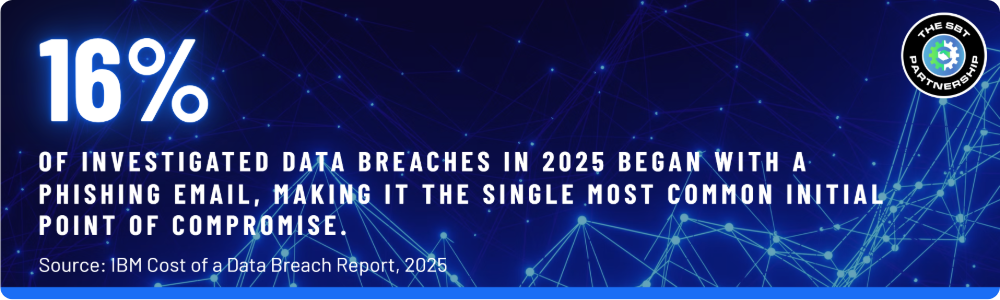
Attackers continue to rely on phishing because it works. Fake invoices, document-sharing requests, and fraudulent Microsoft login pages are designed to look legitimate enough for someone to click before realizing something is wrong.
2
Weak or Reused Passwords
Password spraying, credential stuffing, and purchased credentials from previous breaches all take advantage of one common habit: reusing passwords across multiple systems and accounts.
3
Unpatched Devices
Outdated operating systems, missed security updates, and unsupported software create opportunities for attackers to exploit known vulnerabilities.
4
Lack of Multi-Factor Authentication
Without multi-factor authentication (MFA), a stolen password may be all an attacker needs to gain access to business systems and data.
5
Unmanaged Mobile Devices
Phones, tablets, and personally owned devices that access company data can create security blind spots when they fall outside standardized management and security controls.
Related Read: The Dark Web: One Leaked Password Is All It Takes →

The Data Behind the Risk

Industry research consistently shows that breaches occur through a combination of malicious activity, human error, and technology failures.

Malicious Attacks or Cyberattacks 51%
Human Error 26%
IT System Failure 23%
Source: IBM Cost of a Data Breach Report, 2025

That final category is often overlooked. Nearly one-quarter of breaches stem from technology failures rather than direct attacks, highlighting the importance of proactive monitoring, maintenance, and security management. Research also continues to show that phishing remains one of the most effective attack methods.

What Does a Data Breach Actually Cost?

The financial impact of a breach depends on the size of the organization, the type of data involved, and how quickly the issue is identified and contained. For small and midsized organizations, breach costs typically fall within the following ranges:

Company Size
Estimated Breach Cost
10 Employees
$25,000 – $100,000
50 Employees
$50,000 – $250,000+
100 Employees
$100,000 – $500,000+
Enterprise Organizations
Often Millions
What surprises many business leaders is that these costs rarely come from a single source. Instead, the total impact is usually a combination of:
  • Recovery costs, including incident response, forensic investigations, legal support, insurance claims, and security remediation.
  • Operational downtime, meaning employees unable to work, delayed projects, missed deadlines, and disrupted business operations.
  • Customer impact, including eroded trust, contract concerns, lost opportunities, and reputational damage that may persist long after recovery.
  • Compliance and regulatory requirements, such as reporting obligations, audits, penalties, and industry-specific compliance activities.
While ransomware payments often receive the most attention, productivity loss and operational disruption frequently represent the largest financial burden.

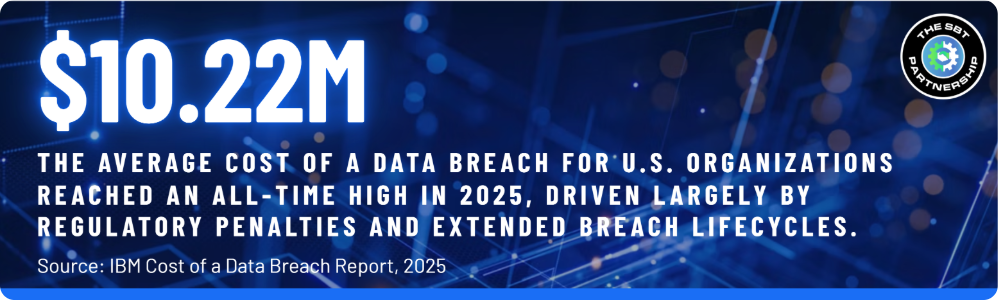
To put the broader impact into perspective:

What a Breach Can Look Like for a 50-Person Business

Statistics are helpful, but real-world scenarios often tell the story more clearly. A typical breach may unfold like this:

Day 1 — An employee clicks a phishing email.
Day 2 — An attacker gains access to a Microsoft 365 account.
Day 4 — Additional accounts are compromised as the attacker expands access.
Day 7 — Sensitive information is downloaded, systems are encrypted, or both.
Following Weeks — Recovery efforts begin. Password resets, security investigations, operational disruption, customer communication, and cleanup efforts consume valuable time and resources.

By the time the business realizes what happened, the initial compromise may have occurred days or even weeks earlier.

How a Proactive Technology Strategy Helps Reduce Risk

No organization can eliminate risk entirely. However, businesses that take a proactive approach can significantly reduce both the likelihood and the impact of a breach. Effective protection comes from multiple layers working together within a single, accountable framework.

1
Security Monitoring
Detects unusual activity before minor issues become major incidents.
2
Multi-Factor Authentication
Protects business accounts even if credentials are compromised.
3
Security Awareness Training
Helps employees recognize phishing attempts and other common threats.
4
Endpoint Protection
Identifies and blocks malware, ransomware, and suspicious activity across devices.
5
Vulnerability Assessments
Uncovers weaknesses before attackers have the opportunity to exploit them.
6
Dark Web Monitoring
Provides visibility when business credentials appear in known breach databases.
7
Backup and Recovery Planning
Reduces downtime and helps restore operations quickly after an incident.
Without a Proactive Strategy
✗ Warning signs go unnoticed
✗ Compromised accounts remain active for extended periods
✗ Reused credentials create multiple points of exposure
✗ Response efforts begin after the damage has already occurred
With a Proactive Strategy
✓ Suspicious activity is identified quickly
✓ Exposed credentials can be addressed before they are used
✓ Recovery processes are tested and ready when needed
✓ Security becomes part of daily operations rather than an emergency response
Related Read: You Have Security Tools. But Do You Have a Security Plan? →

Quick Self-Assessment: Are You More Exposed Than You Think?

Many organizations discover security gaps only after an incident occurs. Consider the following questions:

✓
Do employees reuse passwords across business and personal accounts?
✓
Has it been months since privileged accounts or shared credentials were reviewed?
✓
Would you know if employee credentials appeared in a public breach database?
✓
Do former employees, vendors, or contractors still have active access to systems?
✓
If a security incident occurred tonight, would you know within hours or weeks?

If any of these questions create uncertainty, they may reveal opportunities to strengthen your overall security posture.

The Cost of Prevention Is Almost Always Lower Than the Cost of Recovery

A data breach does not have to put a business out of operation to create significant financial and operational consequences. For many small and midsized organizations, even a few days of downtime can result in lost revenue, frustrated customers, delayed projects, and disruptions that extend far beyond the initial incident.

The encouraging reality is that most common causes of breaches are preventable. Strong security practices, ongoing monitoring, employee awareness, and intentional technology planning can significantly reduce risk while improving visibility and resilience. The goal is not simply to add more security tools. The goal is to create a technology strategy that supports business continuity, protects critical operations, and helps your organization make technology decisions on purpose, not by accident.

SBT Partners

Wondering Where Your Biggest Security Risks Are?

An IT assessment can help identify vulnerabilities before attackers do. Contact SBT Partners to start the conversation.

CLAIM YOUR FREE IT HEALTH CHECK→

Share This Post

  • Share on Facebook
  • Share on X
  • Share on WhatsApp
  • Share on Pinterest
  • Share on LinkedIn
  • Share on Tumblr
  • Share on Vk
  • Share on Reddit
  • Share by Mail

More Like This

The Real Cost of a Data Breach for a Small Business

Cybersecurity
Small and midsized businesses are frequent breach targets due to fewer security controls. See what a data breach actually costs, its most common causes, and how proactive IT reduces risk.
August 20, 2026
https://www.sbtpartners.com/wp-content/uploads/2026/08/Designer-39.png 1024 1536 [email protected] /wp-content/uploads/2023/11/SBT-Logo-Color_a3b47f75244ae0f19b0c6e42706a26e8-1.png [email protected]2026-08-20 14:40:402026-08-20 14:41:42The Real Cost of a Data Breach for a Small Business

The Dark Web: One Leaked Password Is All It Takes

Cybersecurity
How the SBT Solution Stack helps identify credential exposures, uncover hidden risks, and proactively protect your business before threats become security incidents.
August 12, 2026
https://www.sbtpartners.com/wp-content/uploads/2026/08/1726750210_img-darkweb.webp 613 871 [email protected] /wp-content/uploads/2023/11/SBT-Logo-Color_a3b47f75244ae0f19b0c6e42706a26e8-1.png [email protected]2026-08-12 14:20:132026-08-14 20:52:58The Dark Web: One Leaked Password Is All It Takes

You Have Security Tools. But Do You Have a Security Plan?

Cybersecurity
The biggest gap for SMBs in 2026 isn't tool availability. It's the governance gap that leaves your existing technology exposed.
April 23, 2026
https://www.sbtpartners.com/wp-content/uploads/2026/04/GettyImages-1348795158-cyber-security.webp 194 345 [email protected] /wp-content/uploads/2023/11/SBT-Logo-Color_a3b47f75244ae0f19b0c6e42706a26e8-1.png [email protected]2026-04-23 10:55:062026-07-14 13:59:22You Have Security Tools. But Do You Have a Security Plan?

How Modern Phishing Bypasses Traditional Email Filters

Cybersecurity
Phishing attacks have changed. Today’s emails look legitimate, arrive at the right moment, and often pass traditional security checks.
April 2, 2026
https://www.sbtpartners.com/wp-content/uploads/2026/04/Phishing.jpg 485 913 [email protected] /wp-content/uploads/2023/11/SBT-Logo-Color_a3b47f75244ae0f19b0c6e42706a26e8-1.png [email protected]2026-04-02 16:16:462026-07-12 13:58:37How Modern Phishing Bypasses Traditional Email Filters

Why iPhone Updates Matter More Than Ever

Cybersecurity
Apple doesn't frequently issue public security warnings, which is why this one deserves attention. If you're not updated, your data is at risk.
March 26, 2026
https://www.sbtpartners.com/wp-content/uploads/2026/03/ios.png 907 1617 [email protected] /wp-content/uploads/2023/11/SBT-Logo-Color_a3b47f75244ae0f19b0c6e42706a26e8-1.png [email protected]2026-03-26 10:50:422026-07-12 13:58:37Why iPhone Updates Matter More Than Ever

The SMB Owner’s Guide to Fewer Tech Headaches

Cybersecurity, Managed IT, The SBT Partnership
Most SMB tech problems are preventable with consistent habits. This concise guide breaks down the five practices that keep your business running smoothly.
February 27, 2026
https://www.sbtpartners.com/wp-content/uploads/2026/02/Untitled-29.png 1080 1080 [email protected] /wp-content/uploads/2023/11/SBT-Logo-Color_a3b47f75244ae0f19b0c6e42706a26e8-1.png [email protected]2026-02-27 09:50:252026-07-12 13:58:40The SMB Owner’s Guide to Fewer Tech Headaches

Cyber Hygiene in 2026

Cybersecurity, Miscellaneous
Cyber hygiene is the foundation of cybersecurity in 2026. Learn how SMBs can defend against threats with smart habits, training, and affordable tools.
November 17, 2025
https://www.sbtpartners.com/wp-content/uploads/2025/11/Screenshot-2025-11-14-114035-1.png 1274 1562 [email protected] /wp-content/uploads/2023/11/SBT-Logo-Color_a3b47f75244ae0f19b0c6e42706a26e8-1.png [email protected]2025-11-17 10:14:592026-07-12 13:58:47Cyber Hygiene in 2026
ReCAPTCHA and Malware: What You Need to Know

ReCAPTCHA and Malware: What You Need to Know

Cybersecurity
Discover how cybercriminals use fake reCAPTCHA and malware and learn practical steps to protect your small-to-midsize business.
May 12, 2025
https://www.sbtpartners.com/wp-content/uploads/2025/05/ReCAPTCHA-and-Malware-What-You-Need-to-Know.jpg 1250 2000 Abstrakt Marketing /wp-content/uploads/2023/11/SBT-Logo-Color_a3b47f75244ae0f19b0c6e42706a26e8-1.png Abstrakt Marketing2025-05-12 08:52:232026-07-12 13:58:57ReCAPTCHA and Malware: What You Need to Know
Worker at office desk on phone call

Vishing: What It Is, How It Works, and How You Can Prevent It

Cybersecurity
Learn how vishing, or voice phishing, puts your sensitive information at risk, and discover practical steps you can take to keep your business protected.
April 4, 2025
https://www.sbtpartners.com/wp-content/uploads/2025/04/Worker-at-office-desk-on-phone-call.jpg 1250 2000 Abstrakt Marketing /wp-content/uploads/2023/11/SBT-Logo-Color_a3b47f75244ae0f19b0c6e42706a26e8-1.png Abstrakt Marketing2025-04-04 17:14:062026-07-12 13:58:58Vishing: What It Is, How It Works, and How You Can Prevent It
Previous Previous Previous Next Next Next

Categories

  • AI
  • Cloud Computing
  • Cloud Solutions
  • Copilot
  • Cybersecurity
  • Data Backup
  • Help Desk
  • InTune
  • IT Roadmap
  • Managed IT
  • Managed Services
  • Miscellaneous
  • Modern Workplace
  • News
  • Office 365
  • SharePoint
  • Technology as a Service
  • The IT Strategy Committee
  • The SBT Partnership
  • Total IT Management

Contact Us

"*" indicates required fields

This field is for validation purposes and should be left unchanged.

What We Do

AI Solutions

Helpdesk

Cybersecurity

Microsoft 365

Virtual CIO

Collaboration

Data Backup

Business Continuity

Modern Cloud Services

Infrastructure & Endpoint Management

The SBT Partnership

SBT Solution Stack

The Modern Workplace

Technology as a Service

Procurement as a Service

IT Strategy Committee

SBT Partnership Rewards

About Us

Locations

Contact Us

Charlotte
1619 Providence Road S, Suite 220-135
Marvin, NC 28173

(704) 626 1001

Detroit
143 Cadycentre, Suite 166,
Northville, MI 48167

(313) 251 4031

Website by Abstrakt Marketing Group ©
  • Privacy Policy
  • Sitemap
  • Linkedin
  • YouTube
Scroll to top Scroll to top Scroll to top

This site uses cookies. By continuing to browse the site, you are agreeing to our use of cookies.

AcceptLearn more

Cookie and Privacy Settings


How we use cookies

We may request cookies to be set on your device. We use cookies to let us know when you visit our websites, how you interact with us, to enrich your user experience, and to customize your relationship with our website.

Click on the different category headings to find out more. You can also change some of your preferences. Note that blocking some types of cookies may impact your experience on our websites and the services we are able to offer.

Essential Website Cookies

These cookies are strictly necessary to provide you with services available through our website and to use some of its features.

Because these cookies are strictly necessary to deliver the website, refusing them will have impact how our site functions. You always can block or delete cookies by changing your browser settings and force blocking all cookies on this website. But this will always prompt you to accept/refuse cookies when revisiting our site.

We fully respect if you want to refuse cookies but to avoid asking you again and again kindly allow us to store a cookie for that. You are free to opt out any time or opt in for other cookies to get a better experience. If you refuse cookies we will remove all set cookies in our domain.

We provide you with a list of stored cookies on your computer in our domain so you can check what we stored. Due to security reasons we are not able to show or modify cookies from other domains. You can check these in your browser security settings.

Other external services

We also use different external services like Google Webfonts, Google Maps, and external Video providers. Since these providers may collect personal data like your IP address we allow you to block them here. Please be aware that this might heavily reduce the functionality and appearance of our site. Changes will take effect once you reload the page.

Google Webfont Settings:

Google Map Settings:

Google reCaptcha Settings:

Vimeo and Youtube video embeds:

Accept settingsHide notification only
  • Quick Quote
  • Speak to an Expert
  • Remote Support