
 https://www.sbtpartners.com/wp-content/uploads/2026/09/Designer-43.jpg
1024
1536
[email protected]
/wp-content/uploads/2023/11/SBT-Logo-Color_a3b47f75244ae0f19b0c6e42706a26e8-1.png
[email protected]2026-09-10 14:06:352026-09-10 15:32:10What Industries Are the Most Vulnerable to Cyber Attacks?
https://www.sbtpartners.com/wp-content/uploads/2026/09/Designer-43.jpg
1024
1536
[email protected]
/wp-content/uploads/2023/11/SBT-Logo-Color_a3b47f75244ae0f19b0c6e42706a26e8-1.png
[email protected]2026-09-10 14:06:352026-09-10 15:32:10What Industries Are the Most Vulnerable to Cyber Attacks?Most organizations don’t discover compromised credentials until long after they’ve been exposed. Here’s how passwords end up on the dark web, why years-old breaches can still create risk today, and how the SBT Solution Stack, powered by Dark Web ID intelligence, helps identify exposed credentials before they become costly security incidents.
How Passwords End Up on the Dark Web
There isn’t just one way a password gets exposed — it’s usually one of three paths, and none of them require your business to have done anything wrong.
1
Data Breaches at Third-Party Sites
When a retailer, software vendor, or app your employee uses gets breached, the login credentials tied to that account — often a work email address — get dumped and sold in bulk. You never touched that site's servers, but your business email is still sitting in the leak.
2
Credential Stuffing and Password Reuse
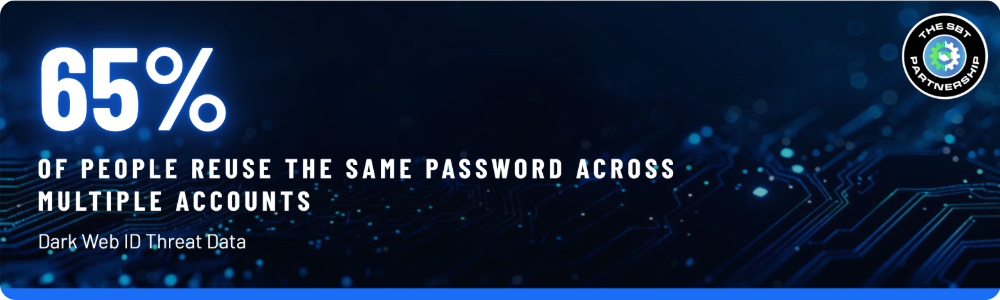
Once a password leaks from one breach, attackers automatically try that same email-and-password combination against banking sites, email providers, and business logins everywhere else — which only works because so many people reuse passwords in the first place.
3
Phishing and Malware-Based Theft
Fake login pages, malicious attachments, and infostealer malware are built for one purpose: harvesting credentials directly off a device or out of a browser, then feeding them into dark web marketplaces within hours.
Related Read: How Modern Phishing Bypasses Traditional Email Filters →
Why a Compromised Password Is Still Dangerous — Even If It’s Old
“That breach happened years ago, so it doesn’t matter anymore” is one of the most common — and most costly — assumptions in small business security. In reality, an old password is only harmless if nobody is still using it, or a variation of it, anywhere.
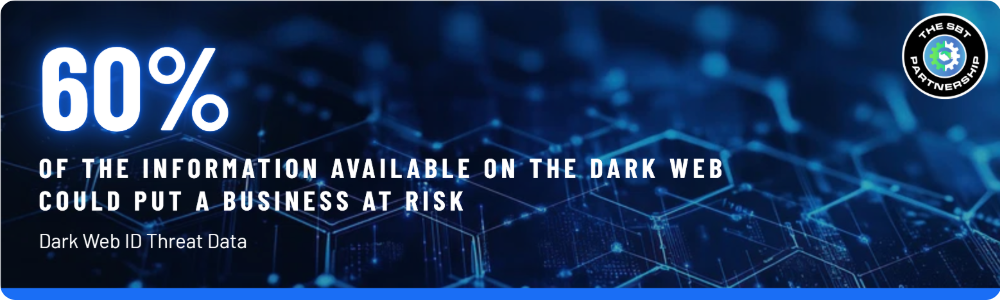
Because so many people reuse passwords across personal and work accounts, an old leak can still open the door to a current system. Verizon’s 2026 Data Breach Investigations Report found that compromised credentials remained one of the most common types of data exposed in breaches, showing up in more than a quarter of the incidents investigated — proof that leaked logins are still a live threat, not a historical footnote.
Related Read: Cyber Hygiene in 2026 →
What Is Managed Dark Web Threat Intelligence?
Managed Dark Web Threat Intelligence is a continuous monitoring service built into The SBT Solution Stack. It’s powered by the industry-leading platform Dark Web ID, that scans breach data, hidden marketplaces, and criminal forums for credentials tied to your business’s email domain. When it finds a match, it flags it as a compromise so it can be acted on immediately — instead of sitting there unnoticed for months or years.
This isn’t limited to Microsoft 365 accounts. Any breach anywhere on the internet that includes a work email address — a hacked forum account, a compromised SaaS tool, an old newsletter signup — can surface a risk to your business.
How SBT Turns Threat Intelligence Into Action
Monitoring is only useful if someone actually does something with the alert. Here’s what happens behind the scenes when Dark Web ID flags a compromise for one of our clients:
1
Automatic Alerting
A compromise is detected and routed straight into our ticketing system (Autotask), so it's tracked and never buried in an inbox.
2
A Live Phone Call — Not Just an Email
This is where SBT does things differently. An email alert is easy to miss or ignore, so our team calls the affected user directly to confirm the compromised password and walk them through next steps in real time.
3
A Prompted Reset
The user resets the compromised password — and any other account where it was reused — closing the door before it's tested by an attacker.
Without SBT Solution Stack
✕ Compromised passwords sit unnoticed for months or years
✕ No alert until the account is already used against you
✕ Personal account breaches never get connected to your business
✕ One reused password can open several doors at once
With SBT Solution Stack
✓ Alerts arrive the moment a match is found, 24/7/365
✓ A live phone call — not just an email — walks the user through next steps
✓ Executive and personal email accounts get covered too
✓ Feeds directly into your broader security plan
Dark Web ID is one of many integrated capabilities within the SBT Solution Stack. Included as part of Total IT Management, it works alongside Microsoft 365 Business Premium and other security controls to provide proactive visibility into credential exposure, strengthen cyber resilience, and help keep your organization ahead of evolving threats.
What This Means for Your Business
Most small business cybersecurity efforts are reactive, identifying problems only after they’ve disrupted operations. The SBT Solution Stack takes a more proactive approach, combining layered security, continuous monitoring, and threat intelligence to help uncover risks before they become incidents. Dark web intelligence is just one of many capabilities working behind the scenes to strengthen your organization’s security posture.
Signs your business may already be exposed:
- Employees use the same or similar passwords across business and personal accounts
- Privileged, administrative, or shared credentials have not been reviewed or rotated on a regular basis
- Your organization lacks visibility into credential exposures occurring outside your internal network
- Former employees, vendors, or contractors may still have active accounts or lingering access permissions
FAQ
Is Dark Web ID only for Microsoft 365 accounts?
No. It monitors for any breach anywhere on the internet tied to a work email address, not just Microsoft accounts.
How often does Dark Web ID scan for breaches?
Monitoring runs continuously, 24/7/365, rather than on a periodic scan schedule — so alerts go out as soon as a match is found.
What should I do if I get a compromised password alert?
Reset the flagged password immediately, along with any other account using that same password. If you're an SBT client, our team will already be reaching out to walk you through it.
Does a compromised password mean I've been hacked?
Not necessarily. It means the password has been exposed somewhere and is now available to attackers — which is exactly why catching it early, before it's used, matters.
https://www.sbtpartners.com/wp-content/uploads/2026/09/Designer-43.jpg
1024
1536
[email protected]
/wp-content/uploads/2023/11/SBT-Logo-Color_a3b47f75244ae0f19b0c6e42706a26e8-1.png
[email protected]2026-09-10 14:06:352026-09-10 15:32:10What Industries Are the Most Vulnerable to Cyber Attacks? https://www.sbtpartners.com/wp-content/uploads/2026/08/Designer-39.png
1024
1536
[email protected]
/wp-content/uploads/2023/11/SBT-Logo-Color_a3b47f75244ae0f19b0c6e42706a26e8-1.png
[email protected]2026-08-20 14:40:402026-08-20 14:41:42The Real Cost of a Data Breach for a Small Business
https://www.sbtpartners.com/wp-content/uploads/2026/08/Designer-39.png
1024
1536
[email protected]
/wp-content/uploads/2023/11/SBT-Logo-Color_a3b47f75244ae0f19b0c6e42706a26e8-1.png
[email protected]2026-08-20 14:40:402026-08-20 14:41:42The Real Cost of a Data Breach for a Small Business https://www.sbtpartners.com/wp-content/uploads/2026/08/1726750210_img-darkweb.webp
613
871
[email protected]
/wp-content/uploads/2023/11/SBT-Logo-Color_a3b47f75244ae0f19b0c6e42706a26e8-1.png
[email protected]2026-08-12 14:20:132026-08-14 20:52:58The Dark Web: One Leaked Password Is All It Takes
https://www.sbtpartners.com/wp-content/uploads/2026/08/1726750210_img-darkweb.webp
613
871
[email protected]
/wp-content/uploads/2023/11/SBT-Logo-Color_a3b47f75244ae0f19b0c6e42706a26e8-1.png
[email protected]2026-08-12 14:20:132026-08-14 20:52:58The Dark Web: One Leaked Password Is All It Takes https://www.sbtpartners.com/wp-content/uploads/2026/04/GettyImages-1348795158-cyber-security.webp
194
345
[email protected]
/wp-content/uploads/2023/11/SBT-Logo-Color_a3b47f75244ae0f19b0c6e42706a26e8-1.png
[email protected]2026-04-23 10:55:062026-07-14 13:59:22You Have Security Tools. But Do You Have a Security Plan?
https://www.sbtpartners.com/wp-content/uploads/2026/04/GettyImages-1348795158-cyber-security.webp
194
345
[email protected]
/wp-content/uploads/2023/11/SBT-Logo-Color_a3b47f75244ae0f19b0c6e42706a26e8-1.png
[email protected]2026-04-23 10:55:062026-07-14 13:59:22You Have Security Tools. But Do You Have a Security Plan? https://www.sbtpartners.com/wp-content/uploads/2026/04/Phishing.jpg
485
913
[email protected]
/wp-content/uploads/2023/11/SBT-Logo-Color_a3b47f75244ae0f19b0c6e42706a26e8-1.png
[email protected]2026-04-02 16:16:462026-07-12 13:58:37How Modern Phishing Bypasses Traditional Email Filters
https://www.sbtpartners.com/wp-content/uploads/2026/04/Phishing.jpg
485
913
[email protected]
/wp-content/uploads/2023/11/SBT-Logo-Color_a3b47f75244ae0f19b0c6e42706a26e8-1.png
[email protected]2026-04-02 16:16:462026-07-12 13:58:37How Modern Phishing Bypasses Traditional Email Filters https://www.sbtpartners.com/wp-content/uploads/2026/03/ios.png
907
1617
[email protected]
/wp-content/uploads/2023/11/SBT-Logo-Color_a3b47f75244ae0f19b0c6e42706a26e8-1.png
[email protected]2026-03-26 10:50:422026-07-12 13:58:37Why iPhone Updates Matter More Than Ever
https://www.sbtpartners.com/wp-content/uploads/2026/03/ios.png
907
1617
[email protected]
/wp-content/uploads/2023/11/SBT-Logo-Color_a3b47f75244ae0f19b0c6e42706a26e8-1.png
[email protected]2026-03-26 10:50:422026-07-12 13:58:37Why iPhone Updates Matter More Than Ever https://www.sbtpartners.com/wp-content/uploads/2026/02/Untitled-29.png
1080
1080
[email protected]
/wp-content/uploads/2023/11/SBT-Logo-Color_a3b47f75244ae0f19b0c6e42706a26e8-1.png
[email protected]2026-02-27 09:50:252026-07-12 13:58:40The SMB Owner’s Guide to Fewer Tech Headaches
https://www.sbtpartners.com/wp-content/uploads/2026/02/Untitled-29.png
1080
1080
[email protected]
/wp-content/uploads/2023/11/SBT-Logo-Color_a3b47f75244ae0f19b0c6e42706a26e8-1.png
[email protected]2026-02-27 09:50:252026-07-12 13:58:40The SMB Owner’s Guide to Fewer Tech Headaches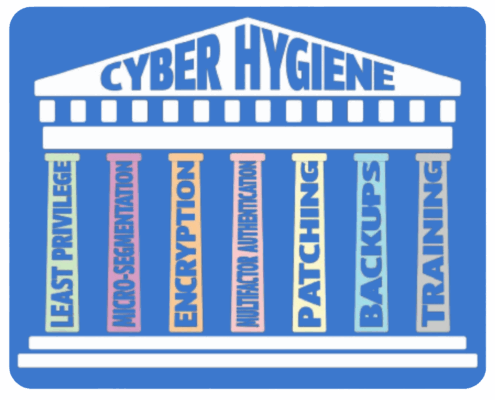 https://www.sbtpartners.com/wp-content/uploads/2025/11/Screenshot-2025-11-14-114035-1.png
1274
1562
[email protected]
/wp-content/uploads/2023/11/SBT-Logo-Color_a3b47f75244ae0f19b0c6e42706a26e8-1.png
[email protected]2025-11-17 10:14:592026-07-12 13:58:47Cyber Hygiene in 2026
https://www.sbtpartners.com/wp-content/uploads/2025/11/Screenshot-2025-11-14-114035-1.png
1274
1562
[email protected]
/wp-content/uploads/2023/11/SBT-Logo-Color_a3b47f75244ae0f19b0c6e42706a26e8-1.png
[email protected]2025-11-17 10:14:592026-07-12 13:58:47Cyber Hygiene in 2026 https://www.sbtpartners.com/wp-content/uploads/2025/05/ReCAPTCHA-and-Malware-What-You-Need-to-Know.jpg
1250
2000
Abstrakt Marketing
/wp-content/uploads/2023/11/SBT-Logo-Color_a3b47f75244ae0f19b0c6e42706a26e8-1.png
Abstrakt Marketing2025-05-12 08:52:232026-07-12 13:58:57ReCAPTCHA and Malware: What You Need to Know
https://www.sbtpartners.com/wp-content/uploads/2025/05/ReCAPTCHA-and-Malware-What-You-Need-to-Know.jpg
1250
2000
Abstrakt Marketing
/wp-content/uploads/2023/11/SBT-Logo-Color_a3b47f75244ae0f19b0c6e42706a26e8-1.png
Abstrakt Marketing2025-05-12 08:52:232026-07-12 13:58:57ReCAPTCHA and Malware: What You Need to Know